Mars human colony
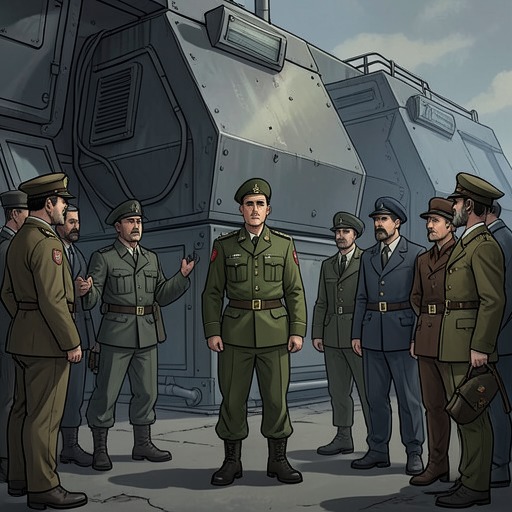
Stranger in a Strange LandThe Mars human colony is an Earth settlement on an inhabited planet, caught between a Federation claim to property and a Martian society that does not organize life around ownership. Its members survive in a hostile environment, but their uncertain standing and the Martians’ reserved response leave the colony’s future unresolved.
Legal Status and Colonial Claims
Before leaving Earth, every member of the advance party signed away individual Larkin rights and assigned them to the government. Captain Willem van Tromp explains that if Mike also waived whatever rights he held, the administration would be positioned to distribute assets on Mars. Ben Caxton questions what those assets could be beyond scientific value, since Mars seems poor real estate for human beings; van Tromp counters that the Moon once appeared equally worthless. The exchange frames colonization not simply as settlement, but as a dispute over who may claim and allocate value.
Mars is already inhabited, complicating the human claim. Mahmoud says the Martians neither objected when the expedition announced its intention to leave a colony nor showed interest or approval. The humans fly their flag and assert extraterritoriality, but Mahmoud cannot determine whether the Martians regard them as legitimate settlers or as something like an ant city under glass. Their apparent permission is therefore not a clear transfer of authority: the humans act under Earth’s legal assumptions while failing to understand the society whose world they occupy.
Survival and Martian Relations
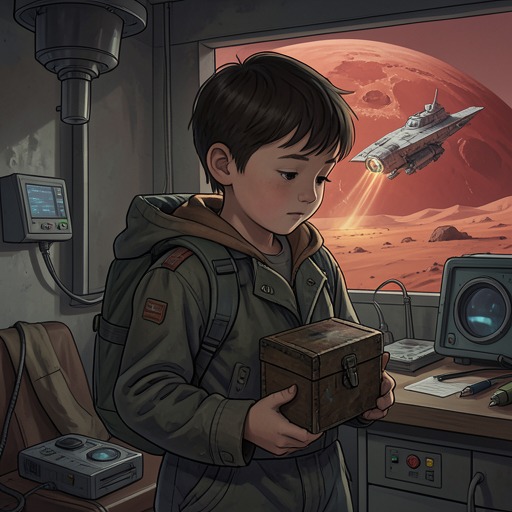
After the spaceship Champion returns to Earth, twenty-three humans remain on Mars. They manage successfully in most respects an environment lethal to unprotected humans, which the narration compares favorably with the Free State of Antarctica. Their survival establishes the colony as a continuing presence rather than a brief expeditionary camp.
The Martians generally leave the settlers alone, but this distance is not hostility. When the human advance guard begins constructing half-buried pressure domes for a larger group of men and women expected on the next ship, the work proceeds faster than scheduled because the Martians help without reservation. The Old Ones neither assist nor obstruct the humans’ longer-term plans, including a preliminary estimate for freeing oxygen bound in Martian sand. Human settlement advances through practical cooperation, even while the deeper political and cultural relationship remains unsettled.
Loss and the Limits of Settlement
The colony’s survival does not remove the emotional and physical costs of remaining on Mars. One of the twenty-three settlers dies through an undiagnosed illness described as heartbreak or homesickness. The Old Ones cherish the wounded spirit and send it back where it belongs for further healing. This loss is distinct from the colony’s material difficulties: the settlers may adapt to the environment, yet the account still registers homesickness as a rupture requiring care beyond the human community.
The colony thus exists alongside, rather than in control of, Martian life. The settlers build habitats and plan to make the planet more hospitable to later generations, while the Martians’ help is not presented as consent to human sovereignty. The contrast between Earth’s assigned property rights and the Martians’ noninterference leaves the settlement’s status open even as its presence becomes permanent.
The Colony and Shared Economies
On Earth, Mike’s household gives the colony’s property question a practical counterpart. Mike discovers the idea of property through gifts sent to him: by giving unwanted items to friends, he learns that an object can be treated as something one person may give another. His later understanding of money is similarly relational. He sees currency not as money in itself but as a shared symbolic structure for balancing, healing, and growing closer.
In the Nest, cash is kept in bowls by the street-facing door. Members take what they need when leaving and return what remains if they remember; Patty replenishes the supply when it runs low. Ben recognizes this arrangement as an enclave of Martian-style moneyless communism, serving as a transition between Martian and Terran economies. He suspects its apparent ease is supported by Mike’s great fortune, but does not ask. The colony’s unresolved encounter with Earth’s property claims therefore echoes inside the Nest: shared practices can coexist with a monetary system, though their material support is not outside that system.
Consequences and Significance
The colony embodies a conflict that extends beyond the allocation of land. Sam warns that Mike’s teaching challenges the prevailing sanctity of property: disciplined people who are not restrained by bank vaults could disrupt markets and conventional measures of wealth. The colony’s legal framework assumes that rights can be assigned and assets parceled out, while the practices associated with Mike and the Martians suggest that money and property are concepts whose rules can be changed.
Mike describes the Nest as a way of teaching discipline and knowledge that could not be taught openly in schools and colleges. He points to its peaceful life, without bitterness or jealousy, as evidence that people can live by different social principles. The Mars human colony is not itself shown adopting those principles; rather, its uncertain claims and practical dependence on Martian cooperation make visible the limits of imposing Earth’s categories on another world. Its future settlement plans continue, but neither the humans’ flag nor their legal instruments settle the question of what Mars is to them.